
Criminal Cases in the Albany County Courts
Albany County Court conducts felony trials at the Albany County Judicial Center. A felony can start with arraignment in Albany, Cohoes, Watervliet, or a town or village justice court. If a grand jury returns an indictment, or the defendant waives indictment and proceeds by superior-court information, the prosecution moves to County Court. The original local court may still hold its own complaint, arraignment entries, and certificate for the part of the case handled there.
City, town, and village courts try misdemeanors, violations, and other matters within their authority. They also conduct preliminary felony proceedings. Outside New York City, Supreme Court generally handles civil work, so it should not be treated as Albany County's routine felony trial court. The distinction keeps searches focused on the right custodian and explains why one prosecution can leave records at more than one clerk's counter.
Albany County Judicial Center Cases
The Albany County Judicial Center is at 6 Lodge Street, Room 113, Albany, NY 12207. Albany County Court lists public hours from 9:00 a.m. to 4:00 p.m., excluding state holidays, and the court line is 518-285-8777. The court can help with calendars, the assigned part, and case-status questions. The County Clerk, however, is the legal custodian of Supreme and County Court records.
Albany County Court
Albany County Judicial Center
6 Lodge Street, Room 113
Albany, NY 12207
518-285-8777
9:00 a.m.–4:00 p.m.
County Clerk Vault Room
County Court House, Room 128
16 Eagle Street
Albany, NY 12207-1077
518-487-5124
8:30 a.m.–4:30 p.m.
The public entrance for the County Court House is on Lodge Street. Visitors should expect security screening. Court pages provide an ADA coordinator route, and the court arranges interpreters for proceedings when requested.
How to Search Case Records
Use OCA WebCrims to locate public appearance information. It works best when the spelling used by the court or the case number is known. A result can identify the court, docket or indictment number, charge, status, next date, and part. It does not provide the full pleading file or a certified disposition.
- Choose defendant or case-number search and use the spelling or identifier shown on court papers.
- Narrow the results to Albany County and the likely city, town, village, or County Court.
- Open the result and note the court, docket or indictment number, appearance date, part, and status.
- Call the originating local clerk for its file, or the County Clerk Vault Room for an Albany County Court case.
- Ask the court of original jurisdiction for a Certificate of Disposition when an official outcome is needed.
The public interface uses these core controls. Filters can change, so the live page controls when a label differs.
| Field Label | Type | Required | Notes |
|---|---|---|---|
| Search by Defendant / Case Number | Tabs | One route | Choose the known identifier route. |
| Last Name | Text | Name route | Enter the spelling used in court. |
| First Name | Text | Name route | Narrows common-name results. |
| Case Number | Text | Case route | Use the court's docket or indictment format. |
| County / Court | Filter | Optional | Narrow to Albany and the originating court when offered. |
Albany County Clerk Case Files
The County Clerk Vault Room supplies copies from unsealed Albany County Court files. Inspection in person avoids the $5 staff-search fee. A mailed search should state the party names and approximate filing date, include the $5 fee, and provide payment for any copies. Regular copies cost $0.65 per page with a $1.25 minimum. Certified copies cost $1.25 per page with a $5 minimum. Paid record requests and filings are not accepted through the clerk's general email.
This route is separate from the county FOIL portal. The County Clerk forms page warns that court files do not belong in that portal. Court records are obtained under clerk duties and court-record fee rules. Call the Record Room at 518-487-5120 for previously filed documents or the Vault Room at 518-487-5124 for court-file copies. A certificate should come from the court of original jurisdiction, since an OCA Criminal History Record Search report is expressly not certified.
OCA CHRS is useful when the court is unknown or a statewide court-derived result is needed. It searches an exact full name and date of birth and charges $95 for each combination. An alias or added birth date is a separate paid search. Eligible open cases and convictions reported by County, Supreme, City, Town, and Village courts can appear, but sealed and other excluded categories do not. Results are normally sent by email, yet a batch with a possible record is held for review. CHRS does not replace the clerk's file, the court's certified disposition, or a subject-only DCJS rap sheet.
What the Case File Shows
A court file tracks the prosecution, not just the arrest. Public fields can include the accusation that reached court, scheduled appearances, motions, rulings, plea or trial result, and sentence. Some source material, including minutes or exhibits, may require a specific request and may not be available online. Grand-jury material, sealed cases, youthful-offender records, victim details, Social Security numbers, and protected personal data stay restricted.
| Case Number & Court | Identifies the local docket or County Court indictment and the clerk that holds it. |
|---|---|
| Charging Document | May be a complaint, information, indictment, or superior-court information. |
| Docket Entries | Record filings, appearances, motions, orders, and other events. |
| Hearing Dates | Show scheduled appearances, time, and calendar part when public. |
| Disposition & Judgment | State the result of each filed charge, such as conviction, dismissal, or acquittal. |
| Sentence & Conditions | Reflect the court's sentence and public financial or supervision terms when reported. |
A police arrest charge, prosecutor-filed charge, and conviction charge may differ. Read each field in its own stage before drawing a conclusion.
Two Albany County Felony Dockets
A felony arrest often appears first under a local criminal-court docket. That court handles arraignment and early proceedings. An indictment or superior-court information then creates the County Court matter. WebCrims may show one or both, depending on status and reporting. Searchers who stop at the city or town docket can miss the later plea, trial result, or sentence.
Write down both numbers and both court names. Ask the local clerk for the complaint, early orders, and any local certificate. Ask the County Clerk for the indictment file, motions, disposition, and sentence. The Albany County Public Defender describes its Counsel at First Appearance work, while its criminal-courts page explains local assignments and diversion settings. Later representation and case assignment follow the court process.
Stages of a Criminal Case
The filed case begins when an accusatory instrument reaches the court. Arraignment states the charges and records a plea. Release or bail is addressed, then discovery and motion practice shape what proceeds. Felonies may require a grand-jury indictment or a waiver of indictment. Conferences can lead to a plea, while unresolved charges may go to trial. The disposition states the result and sentencing follows a conviction.
Case flow: Charges Filed › Arraignment › Pretrial › Plea or Trial › Disposition › Sentencing
After sentencing, an appeal or later sealing order can add entries. The Albany County District Attorney prosecutes County Court matters and may respond to sealing applications, but the DA is not the file clerk. Clerks report dispositions and sentences to DCJS so a fingerprint-supported arrest cycle can be matched with its outcome.
Reading Albany County Case Outcomes
A disposition is the outcome of a charge or case. A conviction follows a guilty plea or verdict. A dismissal ends the dismissed charge without a conviction, while an acquittal is a not-guilty determination. Sentence is a separate field that records the consequence after conviction. Keeping charge, disposition, and sentence apart prevents the initial accusation from being described as the final result.
- Arraignment
- The first appearance when charges are stated and a plea is taken.
- Indictment
- A grand-jury accusation that authorizes felony prosecution.
- Disposition
- The recorded outcome of a charge or case.
- Certificate of Disposition
- The court-issued proof of the outcome in that court.
- Sealing
- A statutory restriction that removes a record from ordinary public view.
CHRS uses exact names and dates of birth, costs $95 per search combination, and can report eligible statewide open cases and convictions. It is broader than one WebCrims appearance, but it is not a DCJS rap sheet and not a certified court record.
New York sentencing labels also require the charged statute. Penal Law section 70.00 addresses felony sentences, while section 70.15 covers misdemeanor and violation jail terms.
Fine entries follow separate provisions. Penal Law section 80.00 governs felony fines, and section 80.05 addresses misdemeanors and violations. Offense-specific rules can still control.
Albany County or Federal Court?
Albany's role as the state capital creates a common custodian trap. A criminal case filed at the federal courthouse belongs to the U.S. District Court for the Northern District of New York, not Albany County Court. Federal dockets use PACER and the federal clerk. The court's fee schedule controls searches, copies, certifications, and archival retrieval. County charges use the local and County Court chain described above.
The Northern District of New York court site shows the separate federal layer.
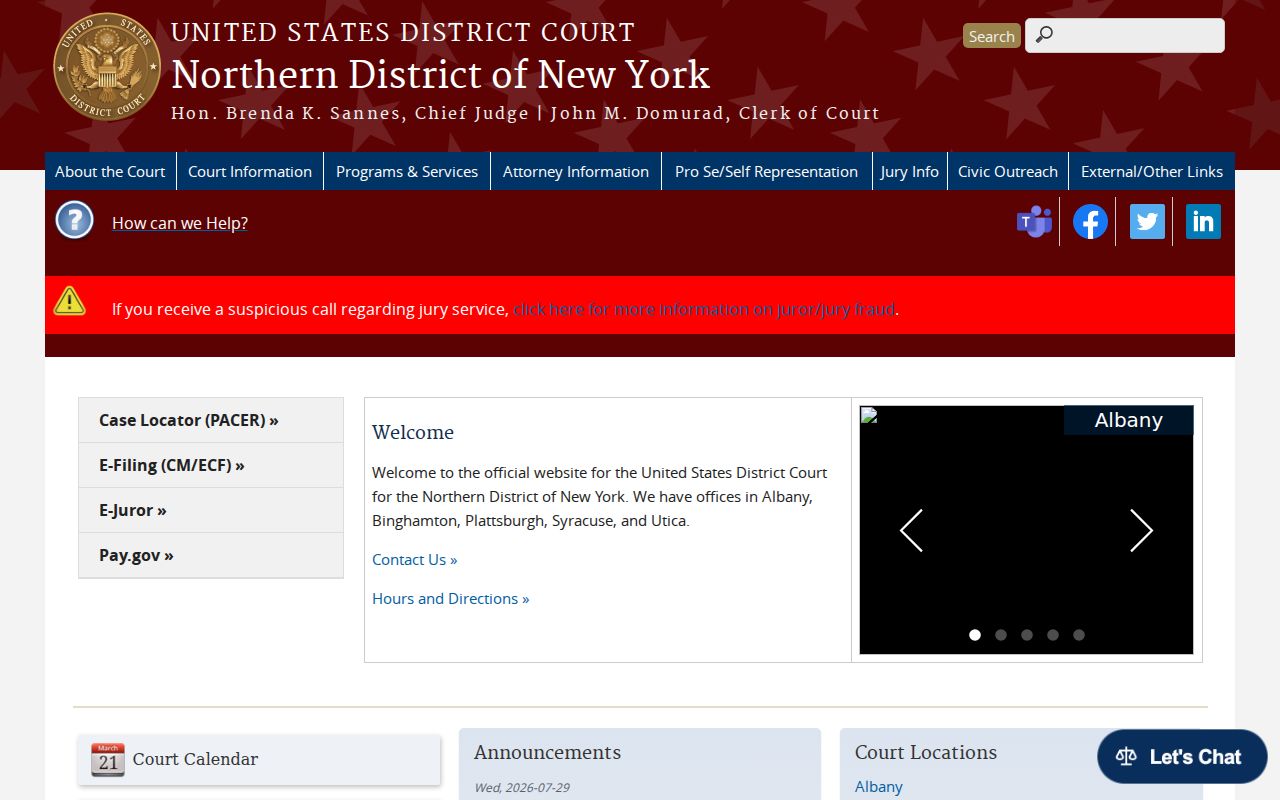
This federal court image reinforces why an Albany address alone does not identify the court system or the clerk holding a criminal case file.
Access & Restrictions
Open Albany County court records can be inspected or copied through the proper clerk, but access is not absolute. CPL 160.50 restricts qualifying cases that end in favor of the accused. Other rules protect sealed convictions, youthful-offender matters, juvenile records, victim-identifying data, medical information, and grand-jury material. An online search can also omit a matter because of spelling, timing, court coverage, or reporting lag.
When a case is missing, confirm the spelling and both docket numbers, then contact the originating clerk. If a sealing order should have removed a case but it remains visible, take the certified order to the source court or clerk first. A later DCJS personal record review can show whether the state arrest cycle was updated. Public silence may be the correct legal result, so it must not be treated as proof that no case ever existed.