
How to Check Criminal History in Albany County
No one search returns every Albany County criminal record. Begin with the question the record must answer. Use OCA WebCrims for public appearance and case-status clues. A local misdemeanor may remain with a City, Town, or Village court, while an indicted felony moves to Albany County Court. The County Clerk Vault Room holds the superior-court file. A police report stays with the agency that created it. Current county custody must be confirmed through the Sheriff because Albany County publishes no official live inmate roster.
Names must match the source. Note aliases, prior names, birth date, the arresting agency, an approximate event date, and any docket, indictment, incident, booking, NYSID, or DIN number already known. Then use the record flow: Police report → jail booking when custody occurs → local court arraignment → Albany County Court after indictment → disposition reported to DCJS. Each handoff creates a different record.
- Search WebCrims for the name or known case number and note the listed court, county, part, and next appearance.
- Call the originating local court for its docket or contact the County Clerk Vault Room for an Albany County Court file.
- Ask the arresting police agency for its incident report through that agency's records or FOIL channel.
- Call the Albany County Correctional Facility when the issue is current county custody; use DOCCS for state prison or parole.
- For a complete review of your own fingerprint-supported state record, schedule a DCJS Personal Record Review through IdentoGO.
Four Albany County Arrest Records
One Albany County arrest can create four records that do not say the same thing. The arresting agency describes the reported event and its basis for acting. The Correctional Facility documents intake and release if a person is booked. The court records the charges actually filed, appearances, rulings, outcome, and sentence. DCJS ties fingerprint-supported arrest cycles to dispositions reported by courts. A later court charge may differ from the arrest charge, and a conviction charge may differ from both.
That split explains many apparent conflicts. A booking entry cannot prove guilt. A police narrative cannot show the final disposition. WebCrims is an appearance tool, not a complete Albany County case file. A DCJS rap sheet is the statewide identity-based record, but it is not open to public name searches.
- Arraignment
- The first court appearance, when charges are stated and a plea is taken.
- Indictment
- A grand jury accusation that authorizes felony prosecution in Albany County Court.
- Disposition
- The recorded outcome of a charge or case, such as conviction, dismissal, or acquittal.
- Sealing
- A legal restriction that removes a qualifying record from ordinary public view without necessarily destroying it.
Note: A public search with no match may reflect spelling, reporting delay, jurisdiction, or lawful sealing rather than proof that no record exists.
Official New York Background Checks
The New York State Division of Criminal Justice Services, Office of Criminal Justice Records, is the sole source of an official New York rap sheet. Its Personal Record Review is for the person named in the record or that person's attorney. The public cannot order another person's DCJS record. Applicants choose a suppressed response, which omits sealed material, or an unsuppressed response, which can include categories hidden from ordinary public access.
The official IdentoGO enrollment service shows the current appointment workflow used for Albany County criminal history self-review.
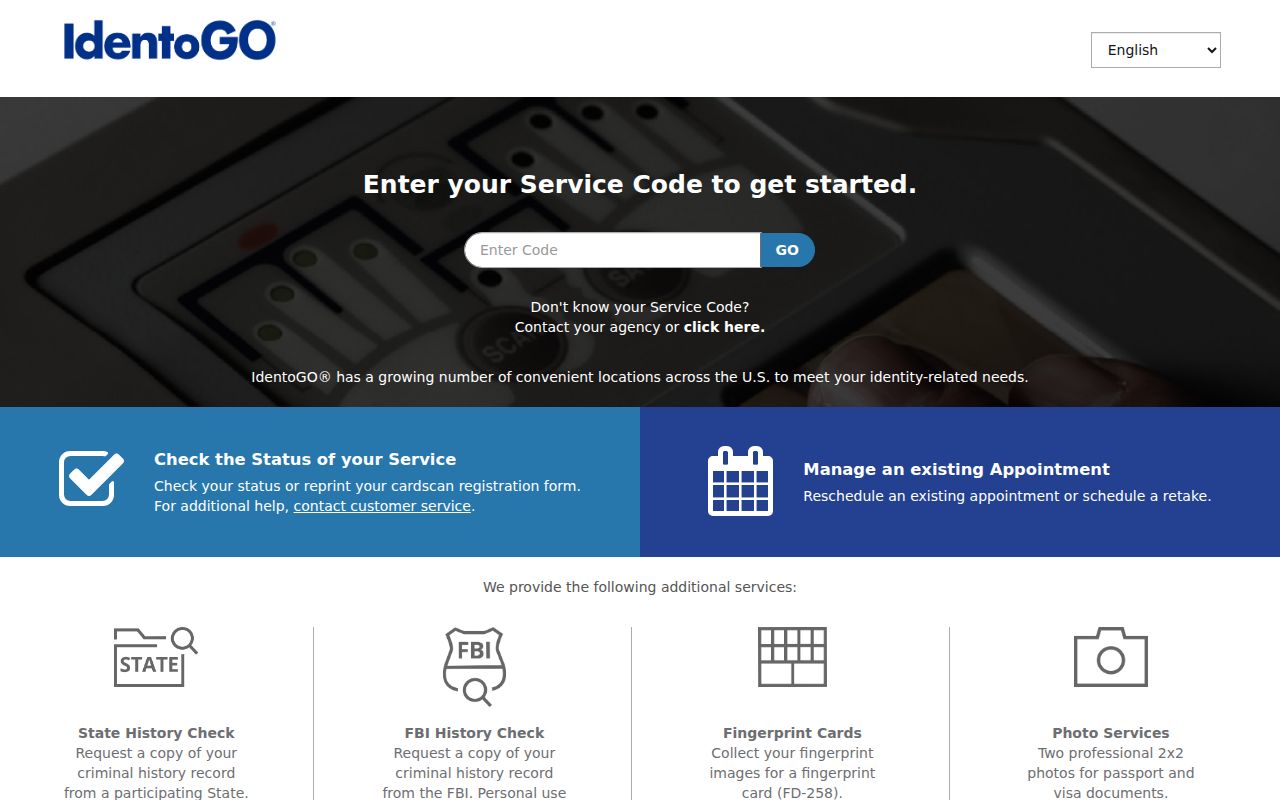
Use service code 15464Z for a suppressed response or 15465F for an unsuppressed response. The DCJS-listed fingerprint charge is $17.50 as of February 2, 2026. Bring acceptable identification. DCJS mails the result in about three to four weeks and includes instructions for challenging errors; it does not offer pickup.
Albany County CHRS Versus DCJS
OCA Criminal History Record Search and DCJS Personal Record Review serve different purposes. CHRS is a statewide court-derived exact-name and date-of-birth search. It costs $95 for each exact combination, and each alias or added birth date is another paid search. It can report eligible open or pending cases and convictions from New York criminal courts, but the result is not certified and does not replace a Certificate of Disposition. DCJS instead matches fingerprints and supplies the subject's official rap sheet.
The DCJS Record Review instructions display the authoritative self-review route and current response choices.
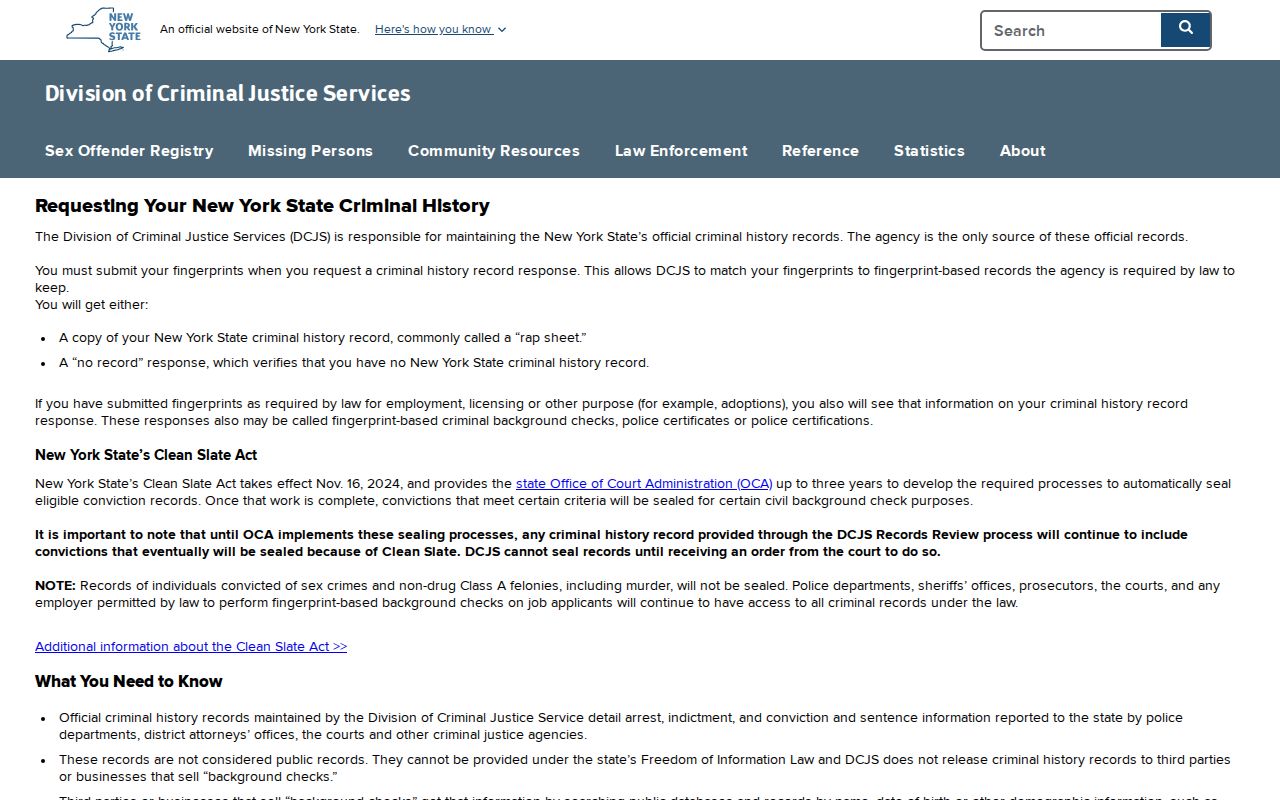
This state page is also where Albany County residents should confirm fees, service codes, processing details, and challenge contacts before an appointment. For CHRS, exact spelling matters and variations are not returned.
| CHRS field | What to enter | Why it matters |
|---|---|---|
| Requester details | Name, address, phone, and email | OCA uses these to deliver or clarify the result. |
| Subject full name | Exact full name | Unclear or incomplete applications can be rejected. |
| Date of birth | Exact birth date | Every added date creates a separate paid search. |
| Alias | Each additional name | Each alias is also a separate $95 search. |
| Delivery and payment | Email or mailed return; current payment method | A mailed request needs the current form and return materials. |
Types of Criminal Records
Albany County agencies create records by event, custody, prosecution, and supervision. An incident report is held by the Sheriff, a city or town police department, State Police, University at Albany Police, or another agency that handled the event. A custodial booking belongs to the Albany County Correctional Facility. Court records sit with the originating local clerk or, for County Court matters, the Albany County Clerk. State prison and parole records are maintained by DOCCS.
- Police and arrest reports: the event narrative, agency action, alleged offenses, and evidence fields, with lawful redactions.
- Booking records: intake identifiers, fingerprints, charges received, custody status, and release information.
- Court case files: accusatory instruments, motions, orders, appearances, disposition, sentence, and certificates.
- Warrant records: the issuing court, type, date, case reference, charge, and execution status when disclosure is lawful.
- Supervision and registry records: limited public information from County Probation, DOCCS parole, or the New York State Sex Offender Registry.
New York offense classes also affect where records form. Albany County Court tries felony indictments. City, Town, and Village courts hear misdemeanors and violations and conduct preliminary felony proceedings. A Class A misdemeanor can carry up to 364 days in jail, while Class B misdemeanors carry up to three months. Felony sentencing varies by class, violent status, and the charged statute, so a case file should control over a broad label.
Albany County Record Custodians
“Filed in Albany” does not always mean filed with Albany County. The county seat is also New York's capital, placing county, city, state, and federal offices within a small area. First identify the government level and the agency that made or received the record. County Clerk staff warn that records said to be “in Albany” may belong to state government. Federal cases go to the Northern District of New York and PACER, not the county courthouse.
The County Clerk Vault Room at 16 Eagle Street, Room 128, supplies County and Supreme Court file copies and can be reached at 518-487-5124. Albany County Court operates at 6 Lodge Street, Room 113, and answers felony court or case-status questions at 518-285-8777. The County Sheriff routes Sheriff-held records and custody questions from 994 Madison Avenue at 518-487-5400.
The Albany County Clerk is the legal custodian of Supreme and County Court records. The judge's court page gives jurisdiction and calendar details, while the Vault Room provides the file. Local-court matters remain with the City, Town, or Village clerk unless a felony advances to County Court.
What an Albany County Criminal Record Shows
The contents depend on the custodian. A DCJS rap sheet groups identity and fingerprint-supported arrest cycles. A court file follows one prosecution through pleadings, orders, appearances, disposition, and sentence. Booking information centers on custody. Read the source label before interpreting a field, since a charge stated at booking may later be reduced, replaced, dismissed, or followed by a different conviction count.
| Name & Identifiers | Names, aliases, date of birth, and state or federal identifiers when lawfully shown. |
|---|---|
| Arrest / Booking Data | Arrest date and agency, booking time or number, custody status, and release information. |
| Charges & Statutes | Arrest allegations, filed counts, offense descriptions, and Penal Law or other code sections. |
| Disposition | Pending, convicted, dismissed, acquitted, or sealed status as reported by the responsible court. |
| Sentence | Jail or prison, probation, fines, restitution, or other court-ordered terms when public. |
| Custody / Supervision | County jail, DOCCS incarceration, probation, parole, or post-release status through the proper system. |
Victim details, Social Security numbers, medical information, grand-jury material, youthful-offender data, and sealed records are not ordinary public fields. A certified disposition must come from the court of original jurisdiction, not from CHRS or a screen print.
Albany County Jail Record Gaps
Albany County does not publish an official live jail roster. For present custody, call the Correctional Facility at 840 Albany Shaker Road through the Sheriff's routing line. The facility holds local, state, and federal court-committed people and reports a current maximum of 866 beds, about 345 staff, more than 2,200 admissions in the cited past year, and average daily population above 450. An older sheriff summary gave different figures, so each statistic should be tied to its source and date.
County jail and state prison are separate. The official DOCCS Incarcerated Lookup is the state-custody search used after a sentenced person enters the New York prison system.
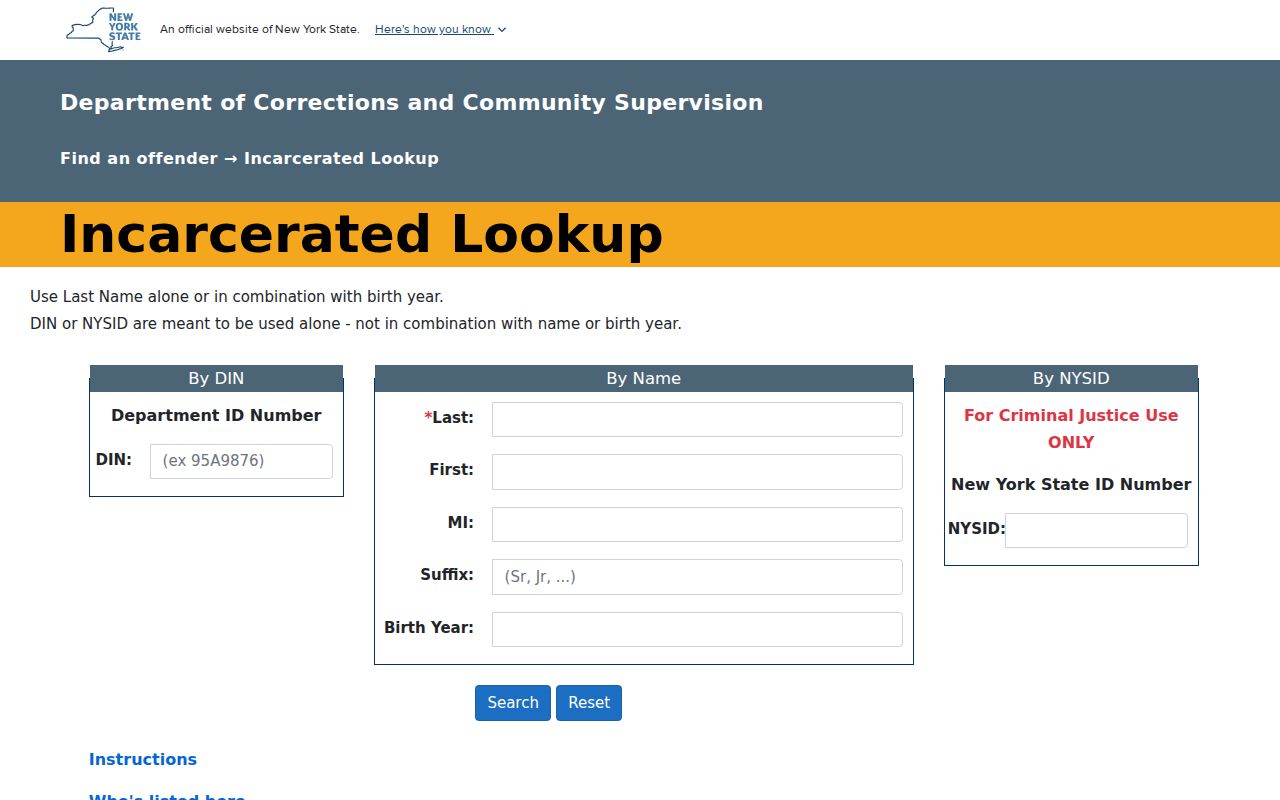
The DOCCS form accepts a DIN, NYSID, or a name route narrowed by first name and birth year. Statutory exclusions mean it is not a full Albany County criminal history. For parole or post-release supervision, use the separate DOCCS Parolee Lookup. Albany County Probation handles local probation, and its private case notes are not a general public database.
Public Access Laws
New York Freedom of Information Law, or FOIL, creates a right to request agency records subject to exemptions. It does not turn every Albany County criminal record into a public file. Police and Sheriff records can be redacted when release would harm an investigation, invade privacy, expose a confidential source, reveal protected methods, or endanger safety. Court files use clerk access laws and court rules. DCJS rap sheets are distributed only as authorized.
Key Albany County record laws:
Public Officers Law article 6 governs FOIL requests, responses, exemptions, and appeals.
Executive Law §837 authorizes DCJS criminal-history systems and controlled dissemination.
Judiciary Law §255 directs clerks to search and certify records when access is lawful and fees are paid.
CPL 160.50 seals records after a qualifying termination in favor of the accused.
CPL 160.57 establishes automatic Clean Slate sealing for eligible convictions.
Within five business days, a FOIL agency generally must grant access, deny the request in writing, or acknowledge it and provide an approximate determination date. A denial should state the appeal route. Court records, registry data, juvenile material, and sealed files each follow their own legal access rules.
Albany County FOIL Versus Court Files
County FOIL does not replace a court-file request. Use Albany County's public information portal for Sheriff or county-department records that are subject to FOIL. Select the responsible department and describe the record, date range, incident or case number, agency, and requested portions. For an unsealed County Court file, contact the County Clerk Vault Room directly. Filings and paid record requests are not accepted through the clerk's general email.
| Albany County service | Charge | Best use |
|---|---|---|
| Personal inspection | No $5 staff-search fee | Review an available unsealed file in person. |
| Clerk staff search | $5 | Locate a file by party name and approximate date. |
| Regular court copy | $0.65 per page; $1.25 minimum | Obtain an ordinary copy from the clerk. |
| Certified court copy | $1.25 per page; $5 minimum | Obtain a clerk-certified record. |
| Ordinary FOIL paper copy | Generally up to $0.25 per page | Agency records up to 9 by 14 inches unless another law controls. |
This fee split is easy to miss. Court-copy charges arise under statutes that govern clerk records, while ordinary FOIL has a different cost rule. A mailed court search needs names, an approximate filing date, the search payment, and copy payment. It should not be sent through the County FOIL form.
Sealed, Expunged & Restricted
New York generally uses record sealing rather than broad adult conviction expungement. CPL 160.50 covers favorable terminations such as an acquittal or qualifying dismissal. CPL 160.55 restricts certain violation or infraction outcomes, and CPL 160.58 addresses specified treatment-related cases. Under CPL 160.59, a person may apply after the statutory wait to seal up to two eligible convictions, with no more than one felony. Sex offenses, Class A felonies, violent felonies, and other listed offenses are excluded.
For an Albany County application, identify each docket and obtain a Certificate of Disposition. Complete the statewide application and sworn statement, give required notice to the Albany County District Attorney, and file with the sentencing court. After an order issues, verify the court record and review a fresh DCJS response. If a sealed case still appears, take the order first to the originating clerk, then use the DCJS challenge process for the state rap sheet.
Sealed does not mean destroyed. Courts, police, prosecutors, DCJS, and other entities named by law may retain access. Youthful-offender and juvenile records use separate confidentiality rules and should not be treated as ordinary public convictions.
Albany County Clean Slate Records
Clean Slate under CPL 160.57 took effect on November 16, 2024, and OCA has up to three years to complete automatic sealing processes. Eligible misdemeanors generally require a three-year crime-free period, while eligible felonies generally require eight years after sentence or release. A pending charge can delay sealing. Sex offenses and non-drug Class A felonies are excluded.
Automatic does not mean instant. Until the court system creates and transmits the order, a DCJS personal review can still show an Albany County conviction expected to qualify later. Anyone checking their own record should compare the court's Certificate of Disposition, any sealing order, and the current DCJS response. A cached search result outside government systems will not update merely because the court record changes.
Note: Clean Slate can restrict ordinary public access while preserving access for police, prosecutors, courts, and other entities authorized by New York law.
Criminal Records by City in Albany County
Albany County's three incorporated cities maintain distinct police and court trails. Albany, Cohoes, and Watervliet police create their own incident records, while each City Court handles local misdemeanors, violations, traffic matters, and felony preliminaries. Indicted felony records then move to Albany County Court. City population figures below are July 1, 2024 Census estimates from the research source.
Albany Criminal History
About 101,228 residents · APD records, Albany City Court, and the felony handoff to County Court
Cohoes Criminal History
About 18,300 residents · Cohoes Police FOIL, City Court, and county booking routes
Watervliet Criminal History
10,268 residents · Watervliet Police records, City Court, and Albany County custody
A city address alone may not identify the arresting agency. University at Albany Police and the Sheriff at Albany International Airport are two local exceptions. Follow the agency named on the report or court record.
Albany County Warrants and Supervision
No official public Albany County active-warrant name search was located. A bench warrant may arise from a missed appearance in a City, Town, or Village court, while another warrant may connect to County Court or a police investigation. Call the issuing court and contact the Sheriff for county execution or custody questions. Active or sealed warrants can be withheld. An absent web result is not proof of clearance, and a person seeking to resolve a warrant should obtain case information and legal advice before arranging an appearance.
Supervision also divides by custodian. Albany County Probation supervises local probation and may use electronic monitoring, but its case notes and treatment data are not public search records. DOCCS supervises parole and post-release cases through the New York State Board of Parole structure. The public Parolee Lookup may show conviction, sentence, status, supervision location, and a listed office contact, though recent changes can lag.
Police reports remain with the agency that made them. Sheriff incidents use the county route, Albany Police has a separate subject-report route plus City Clerk FOIL, and Cohoes or Watervliet records use their city channels. This custodian-first method prevents a court search, jail call, or state lookup from being mistaken for the whole Albany County criminal history.